
Singh said the Modi government has changed the approach adopted by previous governments that the border areas are buffer zones between the plains and the potential adversary.

To understand Modi, listen to what he does not say -- vide NRC, suggests Prem Panicker.

'We like certain stocks from banking, insurance, retail, hospitals and capital goods.' 'Though some of these stocks may seem expensive, they will compound well over the long term, thus justifying their current multiples.'

At a time when the overall narrative is around India being an attractive investment destination, the two American multinationals are more specific in projecting India as their centrepiece.

The government on Thursday tweaked curbs on imports of laptops and computers as it allowed importers to bring in shipments of IT hardware from overseas on a mere 'authorisation' upon detailing quantity and value. The new 'import management system' is aimed at monitoring shipments of laptops, tablets and computers into the country without hurting market supply or creating a cumbersome licensing regime. The announcement is likely to provide relief to companies in the IT hardware segment in India as they had flagged concerns over the imposition of a strict licensing regime for importers.

N R Narayana Murthy, co-founder of Information Technology giant Infosys, has lamented that economic activities in India were 'stalled' and decisions were not taken by the Manmohan Singh government in time in the Congress-led United Progressive Alliance-era.

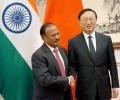
'Russian diplomacy is presumably at work.' 'The ground is slippery, because "territorial sovereignty" is a hugely sensitive issue,' says Ambassador M K Bhadrakumar.

China's new confidence 'borders on arrogance' which is starting to create problems for world affairs, Kenneth G Lieberthal, director, John L Thornton China Center and Senior Fellow at the Brookings Institution said in New Delhi.

'Das is friendly, but he finally does what he does. The quality of engagement is very good.'

'When manufacturing or even services cannot generate the kind of employment they are looking for, they prefer to be unemployed rather than under-employed.'

The 55 basis point (bps) spike in the US 10-year bond yield, triggered by a combination of FOMC's hawkish commentary and BOJ's relaxation of the yield control curve (YCC) has made analysts cautious on Asian equities and expect them to trade sideways in the short-to-medium term.

Home-grown companies, including electronics manufacturing services (EMS) firm Dixon Technologies and mobile device maker Lava International, have started exploratory talks with Chinese sub-assemblies and component players for setting up joint ventures (JVs) in the country. Sources in the industry say many domestic companies have also had preliminary discussions with original design manufacturers (ODMs) in China to look at a JV model for manufacturing smartphones. Key ODM players in mobile devices in China include Longcheer, Huaqin, and Wingtech, which has already set up a plant in Tirupati.

'Under-employment continues to be a very big problem.' 'What we see today is many youth who would have accepted any kind of job are not willing to accept any job.' 'They are ready to wait for a better job, one that justifies their educational qualification. 'This is one of the reasons why unemployment has risen.'

Import duty on PVC, at 7.5%, is far lower than that prevailing in comparable economies.

Rising crude oil prices, traction in China equities and inflation concerns back home are casting a shadow on the Indian equity markets in the short term, believe analysts at Jefferies. They said this could see the markets remaining range-bound in the near term before the next leg up.

The men with guns tend to know little finance, and establishing such a conspiracy then involves leakage of information, which is also dangerous, Ajay Shah points out.

China has sought information on India's poverty reduction programmes, including the Mahatma Gandhi National Rural Employment Guarantee Scheme, to beef up its own strategy.

India must be prepared to deal with climate disasters, geopolitical confrontations, and social strife linked to global events, asserts Jayant Sinha, chairman of Parliament's Standing Committee on Finance.

Capital markets regulator Sebi has permitted mutual funds to again invest in foreign stocks within the aggregate mandated limit of $7 billion for the industry. This came in the wake of a major correction in global markets that brought down the valuation of international stocks. In January, Sebi had asked mutual fund houses to stop taking fresh subscriptions in schemes investing in overseas stocks. The directive to stop subscription was mainly on account of the mutual fund industry crossing the mandated limit of $7 billion for overseas investments.
Domestic investors have been increasingly investing in overseas stocks in a bid to diversify their portfolio. US stocks are the favourite for individual investors, though they have been increasingly looking at Chinese equities given the relatively attractive valuations. However, the regulatory crackdown in China and the latest concerns around Evergrande default have resulted in sub-par returns for investors. Edelweiss Greater China Equity Off-shore Fund and Axis Greater China Equity Fund of Fund are down 11 per cent in the past three months, the data from Value Research shows.

'Clearly, the warming of ties can be a 'win-win' for India and China,' says Ambassador M K Bhadrakumar.

'Our equations with China require engagement and not confrontation; its interfaces with Pakistan and with some other South Asian neighbours also add to the complexities,' says Vice Admiral Premvir Das (retd).

With its new line-up, the firm has managed to touch the right chords, but to regain market share from the established players, Micromax will have to fight a protracted battle.

'The world over, everybody is asking for the same medicines, same APIs, same KSMs.' 'However, there is just one supplier -- China -- for the entire world.'

The new mantra was to align Apple's ambition with the government's, focusing on Modi's favourite themes of Make in India, employment generation and India as a high-tech export hub.

Apparel exports to Japan are expected to grow by 20-25 per cent year on year from the current $220 million on account of rising opportunities for domestic exports, AEPC said on Saturday. Apparel Export Promotion Council (AEPC) said that rising opportunities due to changing geopolitical landscape, government supports like production linked incentive, mega park scheme, improving the quality standard, getting sustainable and utilising benefits of free trade agreements with major markets are the key growth drivers. To promote exports to Japan, the council is organising a two-day show in Gurugram.

'For the first time since I've been following Indian politics, one heard voters talking about India's role on the world stage and the fact that, due to Modi's leadership, India was once again a great power.'

Grasim Industries has announced a rights issue of around Rs 4,000 crore with the promoters committed to fully subscribing to their entitlements and to covering any unsubscribed portion. This is to part-fund capital expenditure (capex) of Rs 10,000 crore in a new foray into the paints business. The company has already invested Rs 3,640 crore in the paints business (by Q1FY24). The management has outlined a capex of Rs 5,700 crore for FY24, which includes Rs 4,280 crore allocated for the paints business, of which Rs 1,050 crore has already been spent in Q1FY24.

Container Corporation of India (Concor) has been the worst performer among major logistics & port stocks registering returns of about 4 per cent over the past three months as compared to 10-12 per cent for peers Gateway Distriparks and Adani Ports and SEZ. Uncertain outlook on the export-import (EXIM) trade front, market share loss, lack of progress on divestment, and weak June quarter results weighed on the stock. Volume and margin movement will be key triggers for the stock going ahead. As was the case in the previous quarter, margin performance was muted even in the June quarter. Operating profit in the quarter was down 17 per cent at Rs 391 crore missing estimates by over 15 per cent. Operating profit margins at 20.4 per cent, too, were down sharply by 350 basis points over the year-ago quarter.

After ramping up production to meet the steep demand spike during the Covid-19 pandemic, Indian medical device makers are now struggling with idle capacity. According to industry estimates, around a third of the installed capacity, especially for consumables, disposables, small-ticket electronic items, etc., is lying unutilised. Sample this: India used to produce just 6.24 million pieces of PPE kits per annum before the pandemic, but by June this was ramped up to 233.87 million pieces per annum.

'These three commodities have been chosen very well.' 'It is up to the state governments and central government to see how it is implemented.' 'The government has to do some hand-holding.'

The Indian troops guarding the nearly 3,500-km Line of Actual Control (LAC) maintained an assertive approach in sync with the broader national security doctrine and procured a variety of military platforms and weapons to enhance their combat capabilities.

The government is close to approving a proposal by Micron Technology to set up an assembly, testing, marking and packaging (ATMP) facility in the country involving an investment of about $1 billion. The world's fifth largest semiconductor company, based in Idaho, USA, will use the facility to process some of its own wafers, manufactured across the globe.

The India personal computer (PC) market shipment, inclusive of desktops, notebooks, and workstations, dropped by an overall 30.1 per cent in the first quarter of CY2023 over the previous year, to only 2.99 million units, according to the latest data from the International Data Corporation (IDC) Worldwide Quarterly Personal Computing Device Tracker released on Tuesday. In Q1CY23, while the demand for desktops was positive, the notebook category witnessed another weak quarter as it declined by 40.8 per cent year-on-year (y-o-y). The consumer segment declined by 36.1 per cent y-o-y primarily due to slowing demand and weak market sentiment.

Although the pact would focus mainly on the Pacific and the South China Sea region, any action designed to deter China with or without New Delhi's active participation is a welcome move, notes Commodore Venugopal Menon (retd).

A healthy growth in India's services segments has helped the country's total exports and imports of goods and services to cross the $800 billion mark during the first half of 2023, despite a slowdown in global demand, think tank GTRI said in a report on Monday. According to the analysis of the Global Trade Research Initiative (GTRI), exports of goods and services rose by 1.5 per cent to $385.4 billion during January-June this year, as against $379.5 billion in January-June 2022. Imports, however, dipped by 5.9 per cent to $415.5 billion during the six months of this year, as against $441.7 billion in January-June 2022.

During the day-long debate, the lines between science and religion often got blurred with many invoking religious texts and the contribution of 'rishi munis' to highlight India's tryst with the extra-terrestrial world.

Gearing up for the international verification of carbon control measures, China has announced schemes to provide major subsidies for solar power generation which is set to grow at an annual rate of one gigwatt (gw) after 2012.

With a million-odd electric vehicles (EVs) - two-wheelers, e-rickshaws, buses and passenger cars - expected to hit the road this calendar year, the shift from gasoline-powered vehicles has become irreversible. Now the question is whether the supply chain is ready for this shift. Key components - the high-powered lithium-ion battery and the cells which go with it, the electric motor, and the electronics powered by chips - account for nearly 60 per cent of the cost of an EV.
